Showing posts with label seeds. Show all posts

Monday, March 18, 2013

Broccoli - first seedlings of 2013

What a difference a year makes! At this time last year, we'd already planted some seeds outdoors (radishes and spinach), and were a bit worried we were falling behind on our indoor seed starting. This year... well, it snowed this morning, and we've had to keep the chicken coop enclosed because it's getting down to the teens for overnight lows.

But that will all soon change, which is why we've begun our first indoor seeds of the year. You may recall we built up a big seed-starting shelf, which to this point has only held our mostly unsuccessful indoor lettuce project. That's changed in the last few weeks, as you can see here.


The very early season is prime time for cold-hardy crops, of which our favorite has to be broccoli. Last year we enjoyed some unusual (for us) success with broccoli, and we plan to fill an entire garden bed with it this year. Broccoli can be started 6-8 weeks before the last frost, which in central Iowa is usually mid-May. So, now is a pretty good time to get going. We started some last week, and now they've just begun to sprout.


Of course, we really wanted an early batch of broccoli, so we also started some the week before. They look like this:


And, just because we have a cold frame and a low tunnel, we figured we could take some risk, so we even started some the week before that. They've gotten quite big, and you can see some of the "true" leaves forming.


Our goal here is to stagger our planting so that ideally we can also stagger our harvest. These three-week old plants should form full-size broccoli heads first, then we can successively cut the others so we have fresh broccoli over multiple weeks. When you're growing 32 broccoli heads, that makes things a lot more manageable!

Depending on your zone, it's probably not too late to start some broccoli seeds of your own. Otherwise, the next few indoor plants we'll be looking at are peppers (hot and sweet, probably within the next week), and tomatoes, which we'll plant a few weeks thereafter. It's a great feeling when it's still too cold and slushy outside to see these little reminders that spring isn't too far away after all!

Friday, February 8, 2013

Hibernation over!

You may have noticed that we haven't exactly been around here a lot lately. Perhaps unsurprisingly, our disappearance began around the holidays, during a time when we do a lot of traveling to make sure we visit both sides of the family. But then, we kind of never came back. We can blame that on winter being a slow time of year for gardening, or whatever sounds the most plausible. The truth is, we got a little lazy. And the worst part is, it wasn't just with the blog, we slacked off on our garden work too.


Remember these guys? Our little winter project to try to grow lettuce? Well, it's a little hard to determine how well that experiment turned out, since we basically stopped watering them. It turns out lettuce, especially baby lettuce, likes water. Who knew? In a remarkable feat of plant kingdom fortitude, a few of our plants survived, as you can see in the picture, though none of them did much growing. Hopefully that will change soon, because of an exciting new addition to the farm.


That's the new and improved seed-starting and indoor growing shelf. It's four feet wide, which accommodates a full-length shop light and two plant trays. And it's about six feet tall, which means at least three, maybe four shelves of plants growing on it, depending on how we space them. We have the one light fixture that we used last year for seed starting, and purchased (but haven't yet set up) a second. So far we are growing some columbines from seed, the remains of the lettuce experiment, and a reboot of indoor greens with spinach this time. So far the spinach seems to be doing okay, though you can tell it's still very young.


This go-round, we're being much more diligent in our watering, and we've incorporated some plant food (fertilizer) since the storebought growing medium doesn't have much in the way of nutrients. We'll see if we can actually grow something worth harvesting indoors when it's only about 35 degrees outside.

Which is all well and good, but the grow-shelf is going to get a lot more crowded in a few weeks as we begin to add our seed starts for the outside garden. Last year we planted broccoli seeds indoors in late February, and got a simply amazing crop after we transplanted them outside. Broccoli is one of our favorites, so we hope to do at least that well this year. And then we'll have to start peppers, and tomatoes, so it should become a very busy shelf unit.

It's hard to believe that the gardening season is starting and it's only February, but it's what we've been waiting for all winter. And now that things are getting going again, hopefully it will kick us out of our stupor and back into growing again!

Friday, November 16, 2012

Growing a Better Lunch

One of the things they don't warn you about being a grown-up is that you have to make your own lunches. Seriously. Like, either the night before (and who plans that far ahead?) or else early in the morning before work, as you're trying to get your sleepy self dressed and out the door in some sort of societally-accepted state. It's kind of a bummer, and makes us yearn back for the simpler days of being in school, when a brown paper bag would just be ready and waiting in the morning, full of delicious goodies for us to eat at lunchtime. Those days are sadly no more.

So, what's a grown person to do? Well, you can go out to eat, but that gets expensive and likely unhealthy in a hurry. Or you can just deal with the annoyance of having to make your own lunch, and try to offset that by making it as good a lunch as you can. We've certainly come a long way in that regard. It wasn't that long ago that we were packing baloney sandwiches with american cheese on white bread for some of our first working lunches. We gradually transitioned to higher quality lunchmeat on whole grain bread, but even that wasn't ideal. Deli meat is pricey, processed and loaded with sodium, and even eating grains is suspect now if you believe in all these low-glycemic index diets. We tend to have more of an "everything-in-moderation" philosophy, but even so we knew we wanted a change.

Lunch needs to have a protein source, so we started there. What sort of cheap, readily available, healthy protein do we have at our disposal at any time? It's hard to recall exactly, but maybe these gals can help us remember (gratuitous chicken photos!).


Of course, eggs! Our backyard chicken flock provides us with more than enough eggs to each eat one or two a day. The manner in which to serve the eggs was a little less clear though. There's egg salad sandwiches, which are amazing, and which we honestly haven't made enough of. But for the days when we weren't doing that, we decided to make chef salads of sorts, with hard boiled eggs and whatever veggies we had from the garden atop mixed greens. That's a tasty start to a lunch.

Only one problem. Many would argue that salad greens are healthier than deli meat, but honestly, they're not much cheaper. We use about a pound of either one per week, and if we buy what we think to be the higher-quality versions (as close as we can tell), that's still $6 or $7 in what amounts to pretty basic ingredients. Not a really big amount of money, but it adds up over the course of the year, and the greens are certainly not local at this time of year. So we started to think about ways to get salad greens more cheaply and locally. Being farmers, we would certainly grow them ourselves, if only it weren't fall/winter and getting so cold. We egregiously mistimed planting our fall garden, so we're out of luck. Or are we...


As you can see, we've already got a growlight on in the house, attempting to start some columbines (flowers, not even edible!) for a planter bed next spring, but they only take up the left half of the light. The right side was literally shining on nothing. The cats seem to enjoy laying under it, but that doesn't really do us a lot of good. So we ran to the local nursery and picked up a packet of mixed salad green seeds. We already have lots of spinach seeds which we also intend to plant. The goal, or the experiment here, is to try to not only start lettuce indoors, but to actually grow it to a full enough size that we can harvest it and use it to make our lunches. It's not terribly crazy - others online have done the same thing. But it's new for us and we're excited to give it a try.

It's possible this won't work very well, or that it won't save us much money compared to storebought greens. But we're farmers, darn it, and it just feels wrong not to be growing anything! We'll keep you informed as to how this is going, as we try to build a sack lunch that gets closer and closer to being truly "homemade."

Tuesday, March 13, 2012

We're Off And Growing!

That's right, our urban farm is really starting to show signs of growth. And in more ways than one. Let's just say that it was a very busy and active weekend; so much so that it's taken til Tuesday night to find time to write about it! To start with, we headed back to our garden area and found these beautiful green shoots coming up out of the ground.


Those are from the garlic we planted last fall. We planted two varieties, and so far every single clove of Georgian Crystal has some leaves poking up through the mulch. Strangely, not one of the Chesnook Reds has appeared yet, but different types of a plant can have different times to germinate. No need to panic yet, and if nothing else, we're looking at 25 heads of garlic minimum, if we can get them through the growing season. They don't need any maintenance so far, but it won't be too long before they generate long stalks (scapes) that we'll have to trim back. For now, we just wait.

Next we headed over to the cold frame we built, for our cold season crops. It's been a weirdly warm spring so far, so it was over 65 degrees outside when we lifted up a glass pane to check the temperature within.


It might be a little hard to see on the photo, but that's our thermometer reading nearly 100 degrees! It was actually 110 when we first looked, but we lost a little bit of temperature while taking the picture. And honestly, that's fine. 110 degrees is way warmer than we needed for our first few veggies of the year, so we took one of the panes off to vent a little bit. Since it's going to be in the mid-to-high 70s all this week, we'll keep that panel off so we don't cook our seeds. If it were a more typical spring, we'd probably need the glass to capture some heat during the day so things don't freeze overnight.

Even though it's unseasonably warm, we're still starting with cold-hardy crops. It's March in the Midwest; for all we know it could still snow again! For that reason, we stuck with the early season basics in our cold frame.


Spinach, from Burpee, an old packet from the year we first started gardening. Some radishes we nabbed at a bigbox store a few years back. And that guy in the middle is a newcomer. Mache, also known as corn salad, is a supremely hardy salad green that you can supposedly grow well into the winter. Neither of us has ever eaten it before but it really sounded like a good option to try. And we found seeds from Botanical Interests, a neat family owned seed company that prominently refuses to use genetically modified plants. We're eager to see how they turn out.

We planted these seeds into a third of the cold frame box and gave them a good drink of water. The idea is to wait a week or two before planting the next third, and so on for the final portion. If all goes as planned, the harvest times should then be staggered as well, and we'll have a longer window in which to eat all our produce.


So there you have it. We're now up to five types of vegetables that have either sprouted or at least been planted. Garlic, broccoli, spinach, radishes and mache. That sounds like the start to a pretty tasty meal, and it was a good accomplishment for the weekend to get it all going. But believe it or not, that wasn't our main task of the past few days. There was also quite a bit of construction going on. Stay tuned later this week for an update on some pretty significant groundbreaking. Being an urban farmer sure keeps you busy, but it should all be worth it as our plants (and plans) continue to grow!

Tuesday, March 6, 2012

Shedding Some Light on our Seedlings

Once again, our broccoli seeds didn't need near the 7-10 days predicted on the seed packet to sprout. Within about 3-4 days of planting, several of them had already popped up out of the starting medium. When that happened, we turned off the heat mat and needed to add light. There is a window nearby, but at this time of year in Iowa there isn't near enough sunlight. When that happens, the seedlings literally have to reach for the light, growing tall and spindly.To augment the natural light, we decided to rebuild our grow light from last year.

If you haven't already seen it, the grow light we built is a simple PVC pipe structure. Anyone can build one just like it with minimal tools and a few dollars expenditure of pipe. Here are all the pieces laid out on the floor.


We have three pieces of 1" PVC pipe that are just a bit longer than our light fixture, vertical pieces a few feet long to suspend the light, and two side assemblies that gave us enough width to accommodate seed-starting trays. Those were just made of two shorter pieces joined at a T-fitting. The only slightly tricky part was cutting the pipe; we borrowed a special pipe cutting tool from a friend, but it could have been done with a saw, too.


Here's the grow light frame all put together. We simply pushed the lengths of pipe into fittings (6 elbows and 2 tees) so it can easily disassemble for storage. The top piece of pipe has a couple hooks screwed into it at the right spacing to match the chains from the light fixture.


Our light fixture is a regular 4 foot T8 fluorescent hanging shop light. It holds two light bulbs, and if you really wanted to go nuts, you could buy special (i.e. expensive) full spectrum bulbs designed for growing plants. But you can achieve almost the same effect by using one "warm" and one "cool" white light bulb. This gives the plants nearly all of the light spectrum that they actually use, and doesn't cost a fortune. For just starting seeds, it's a good way to go.

The light should be hung just above the plants, again to prevent them from having to reach for it. Since our light is on a chain, we can raise or lower it by hooking different links to the top bar. These babies need a lot of light, so rather than relying on our memories to turn the light on and off, we've got it plugged into a basic timer to provide 16 hours of light a day. All that leaves us to do is keep the little broccoli plants well watered and they should be fine until we need to transplant them.

For now, the plants seem to be doing pretty well! It's a long way from edible, but it's a start!


Sunday, February 26, 2012

First Seeds of the Season

You hear so much about how kids don't like to eat vegetables, but neither of us ever fit that stereotype. That was probably in large part due to being around a garden and actively helping in the kitchen to see where our food actually came from. But it also can come from the mindset you have about food. When Greg was a little boy, one of his favorite veggies was broccoli, and he still loves it to this day. As a kid, he would pretend the broccoli were tiny trees, and he was a giant dinosaur, chomping the tops off them. We can't promise that he doesn't still do that.

Naturally, this means we're going to plant some broccoli in our garden this year, and this weekend marked the start of the process. Broccoli is a cool-season crop, and if it gets too warm it starts to bolt, or grow flowers. We've had some trouble with this in previous years. So basically what you want is to have a healthy seedling that you can put outside early in the spring. To do that, you need to plant the seeds indoors around this time of year.


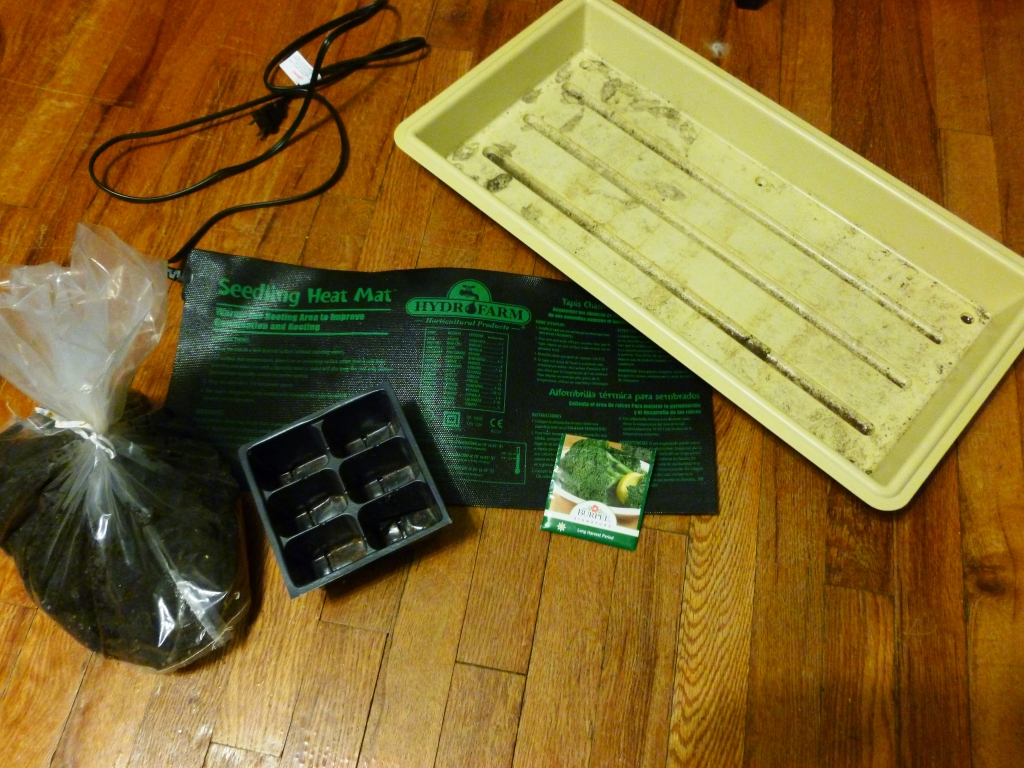
Here's everything we used to get our broccoli started. We have some potting soil, a heat mat, a seed tray, some of those six-pack seed container thingys, and of course, the broccoli seeds. Potting soil is a bit of a misnomer, since it's actually soil-less. Storebought stuff is a mix of mostly peat and vermiculite, or you can make your own using those same ingredients. Ours uses coconut coir in place of the peat, since it's more environmentally friendly and sustainable. Either will work, but don't use actual soil, because it contains micro-organisms that can break down the seeds before they germinate.


Broccoli seeds are tiny! That's a handful of our Burpee Green Goliath seeds that we've been trying to grow for the past few years. We've never had a great harvest so we can't vouch for how tasty this particular variety is, but we're game to give it another shot this year.

Planting the seeds is super easy. We just filled our six packs with potting soil, made a small (1/4 inch, per the packet) indentation, and dropped in one seed per pod. Here you can just barely see the reddish brown broccoli seeds nestled into our little divots.


We topped each seed with a little soil and gave them a good drink of water. The seeds need water to germinate, so we'll be keeping an eye on them and adding water as needed. We set the six-packs into the tray, and set the tray onto the heat mat. We're using a heat mat because broccoli's ideal germination temperature is 80 degrees. Don't worry if you don't have a heat mat, because broccoli can germinate in soils as cool as 40 degrees. Finally we put a plastic cover on the top to retain warmth and moisture.


Burpee thinks these will take up to ten days to sprout, but last year we saw seedlings as early as two days after planting. Once that happens, we'll switch off the heat and focus on providing light. Then in another four to six weeks, we'll hopefully have sturdy little broccoli plants that can handle going outside or at least into our cold frame. And then, if all goes well, it's only a matter of time until we can harvest our tiny trees. CHOMP!

Wednesday, January 18, 2012

What Farmers Do All Winter

So, which of the 2012 models do you like so far? There's that spiffy little Terenzo, though we've also been eyeing the Sunstripe. And you just can't go wrong with Atomic Red, right? Not to worry, those aren't new car models we're so enamored with. This is a blog about farming, so those are actual names of new hybrid vegetable seeds for the coming season. Tomato, squash, and carrot, respectively. Not necessarily our new favorites in those categories, but you have to admit they have some catchy names.

Catchy names, glitzy photos and outrageous claims are everywhere this time of year. That's because farmers, urban or otherwise, can't really do much farming during the cold winter months (you can do some, but we weren't quite ready this year). So what do they do? They give out their addresses to seed companies, and end up with a pile like this!


That's a mixture of this year's catalogs, plus a handful of "back issues" from Greg's Dad to get a feel for a few of his favorite companies. Each one is full of hundreds of varieties, leading to a nearly limitless range of growing options. Especially so when you intend to garden over 400 square feet of space, as we do.

Winter is time for planning, of paging through the catalogs and websites, pitting tomato A against tomato B, and seeing which one you want to be stuffing yourself with by next August (hopefully). Then you have to consider what you've already got: your seed stash, if you will. In our case, it looks like this:


In just four short years of gardening (patio and community) and various changing tastes in what we want to grow, we somehow amassed 30 assorted packets of seeds. And that's only the vegetable ones - there's probably a dozen more herb seed packets stashed away, too. That would be plenty to fill our entire garden space with plants for the year, but there are so many other things we want to try! We've got kale, but wouldn't it be fun to grow collard greens, too? Besides, seeds are only a few bucks a packet and can keep for several years, so why not go a little nuts?

We've almost got our order figured out for the coming year: 10 more packets of various veggies, from green beans to pickling cucumbers. Of course, it's still January, and with months before we can even start planting, who knows how many more we'll decide we just have to have? You can keep your Car & Driver; we'll be here leafing through the new Park Seed for the umpteenth time.