There's been increasing talk lately about the concept of a "Meatless Monday," perhaps coming to a head earlier this summer with a big dust-up between the USDA and the meat industry. First the USDA issued a memo supporting the idea, then various livestock organizations got upset, the USDA retracted the memo and said it never officially endorsed Meatless Monday at all. And for a few days in July, a nice environmental movement was politicized by every talking head on TV. Sigh.
Fortunately, here at You Can't Eat a Lawn, we don't need anybody's permission (the USDA or the Cattlemen) to try something out, and we're happy to introduce a new and hopefully recurring segment about Meatless Monday here on the blog. For the record, we do eat meat, but it's indisputable that the production of meat uses up significantly more resources than plant-based protein sources. For instance, it takes 1800 gallons of water to produce a pound of beef (link), where beans only take 43 (link). So we try to have a meatless dinner at least once a week, and we'll share our favorite recipes here.
This week started with a trip out back to the garden, just like many of our meals have begun all summer long. Unlike the summer months, we were greeted by a small smattering of plants instead of our former cornucopia. But one crop that grows well in Iowa and can tolerate a mild frost is kale, and we had a lot of it! Kale is a really tasty leafy green (in the same family as broccoli) and it's very good for you, full of healthy omega-3's, iron and calcium, just to name a few. We knew this needed to be part of our meatless meal, and luckily we had just the recipe to go with it: Noodle Soup with Kale and White Beans, adapted from Fine Cooking. We'll put our adapted recipe at the end of this post.
As we always do when we start cooking, we began by arranging the ingredients in a pretty formation (kidding!). We were able to make use of a few home grown items in the kale, onion, and our frozen, homemade chicken stock. Other items we bought - we never had good carrots this year, didn't grow celery, and augmented our homemade stock with one box of storebought. Generally speaking, we like to rehydrate dry beans, but we didn't plan ahead enough this week and ended up going with canned. Either one is fine for the recipe; it's just a trade off between the low cost of dry versus the convenience of canned.
As our vegetarian friends will notice, we might have a slightly different definition of "meatless" than others. Yes, we used a chicken stock, but you could just as easily use vegetable stock if that's your preference. We still feel like using chicken stock is in keeping with the spirit of Meatless Monday, because stock is typically made from bones, and those are a by-product that would otherwise be thrown away. We'd rather see those scraps get some use, and since the actual chicken was used in another meal, we're choosing not to count the stock. (We'll make the same exception for lard in the future.) By all means, if you'd rather make a vegetarian soup than a meatless soup, don't let our choice of stock stand in your way.
This is a pretty easy soup to make, with nearly as much time spent chopping things as actually cooking. We first made and sauteed a mirepoix in olive oil. The mirepoix is shown in the picture above - it's really just chopped carrot, onion and celery in about equal proportions. But call it a mirepoix and you're sure to impress your friends! After we'd reveled in our fancy culinary abilities, it was quickly on to everyone's favorite step in soup-making: throw everything in a pot and let it simmer. By the time the savory smell of hot soup on the stovetop becomes too much to bear, everything should be done and it's time to dig in!
This is one of our favorite soups, hearty and flavorful without needing any meat. It has a hint of lime that makes it just as appropriate for the summer, but with enough savory body to warm you up in the fall, too. With the goodness of the kale and the other veggies, you can go back for multiple bowls knowing that this is as good for you as it tastes. It's a delicious option for Meatless Monday, or any day.
Kale and Bean Soup
Ingredients
2 Tbs extra-virgin olive oil
2 medium carrots, peeled and chopped
1 medium onion, chopped
2 ribs celery, chopped
1/2 box whole-wheat spaghetti, broken into thirds
2 quarts chicken stock
1 bunch kale, ribs removed, leaves chopped
1 can cannellini beans, rinsed and drained
3 Tbs lime juice
salt and pepper
1. Finely chop 1 medium onion, 2 carrots, and 2 stalks of celery. Call it a mirepoix and be really proud of yourself.
2. Heat olive oil in skillet and saute mirepoix until tender
3. Combine chicken stock, mirepoix, kale, lime juice and spaghetti in large pot.
4. Simmer 8-10 minutes or until kale is tender and spaghetti is cooked.
5. Salt and pepper to taste, serve and enjoy.
Showing posts with label cooking. Show all posts
Monday, November 5, 2012
Wednesday, October 24, 2012
The Chickens (and the Eggs!)
Although we're fortunate enough to have plenty of excitement and unpredictability in our lives, many days here on the urban farm fall into a comfortable, familiar routine. We go to our day jobs, spend 8 or more hours doing whatever it is that engineers do, come home, gather fresh eggs, and prepare dinner. Oh, wait... That may be our routine these days, but of course the egg part is sort of new, not to mention unusual for city dwellers like us. Our chickens are just so easygoing and low-maintenance that they've become part of our new normal with hardly a second thought.
Part of that may be because we see them every day, but it's been a little while since we've shared any chicken news here on the blog. As you can see in the picture, they've continued to get bigger, and the coloration of some (particularly the Easter Eggers) has changed slightly. But they're still very much the same in temperament. They like to beg for and devour pretty much anything we give them, from the storebought chicken treats to old kitchen scraps to the bugs we want to get out of the garden. And they loved scratching and pecking at the fresh grass in the photo, from the chicken run addition we put on a few weeks ago.
As fun as the chickens are to watch, we got them for a more practical reason: eggs! And in that area they sure haven't disappointed. From the mention last month of our first egg, production has steadily ramped up to the point where we now expect 6 to 8 eggs to be laid each day. Some days every single hen lays an egg and we have nine! From day one to today, we've gathered a whopping 286 eggs.
Now, we both like eggs, but that's a heck of a lot for us to eat. In addition to giving them to neighbors and friends, we've found that keeping a stash of hard-boiled eggs helps use them up. A quick breakfast when we're running late, or chopped up on a salad for lunch, it's just a great thing to have around. But hard boiling farm fresh eggs is more difficult than you might think. You see, we're trying to boil our eggs within days of harvest, whereas a grocery store egg has sat for a few weeks before it even gets to you. This allows some separation to occur between the shell and the membrane inside, so the peeling process goes better.
A really fresh egg doesn't have that gap, so when it comes time to peel after boiling, the shell sticks to the outside of the egg white, and you end up tearing up a lot of egg trying to get the shell off. So, what to do? The secret is to help create that separation yourself. That way you can enjoy fresh eggs without the frustration of a "bad peeler." Here's how we do it.
Use an ordinary pushpin, and poke a hole into the fat end (not the pointy end) of each egg you want to hard boil. This is the scariest step, because the first time you'll feel sure that you're going to shatter the egg. At least, we did. But if you keep up gentle pressure, possibly while rotating the pin back and forth a bit, you'll end up punching just through the shell and not through the membrane. Another reason to like pushpins for this step is that you can usually just push down all the way to the hilt of the pin, and the hole ends up being that proper depth. Sometimes it may push just into the white, but that's actually okay too.
Here's what a half-dozen prepared eggs looks like. You may have to look pretty closely, but you can see the tiny pinhole in each one. Now they're ready to boil! Everyone seems to have a slightly different method for doing this, but here's ours: Bring a pot of water to a boil, place the eggs in using a slotted spoon, bring the water back up to a boil if the eggs have cooled it, then cover the pot and let it sit for 15 minutes. There's actually enough heat in the water at that point to perfectly cook the eggs, and you don't have to keep using gas or electricity to heat it any further.
We mentioned that it's possible the pushpin will poke into the egg white in some instances. Well, again, that's nothing to worry about. You'll just notice a thin ribbon of white stream out of the hole for a bit, then it will separate off and float around in the pot. That small portion of egg is lost, but it's really an insignificant amount, and once it separates away, that should be all of it. The peeled egg may have a small depression in that area, but it's truly worth the risk because...
The eggs will peel perfectly! Here's a batch of ours, following the procedure we just went over. Each one was an absolute dream to peel, especially after the struggles we've had before we discovered this method. We've been happy for a long time to be gathering fresh eggs from our backyard chickens, but it makes it even more rewarding when we can enjoy them that much easier. We've seen a lot of so-called "guaranteed" methods to hard boil eggs, but this is the only one that's worked consistently for us. Give it a try next time you've got some fresh, local eggs, and enjoy!
Part of that may be because we see them every day, but it's been a little while since we've shared any chicken news here on the blog. As you can see in the picture, they've continued to get bigger, and the coloration of some (particularly the Easter Eggers) has changed slightly. But they're still very much the same in temperament. They like to beg for and devour pretty much anything we give them, from the storebought chicken treats to old kitchen scraps to the bugs we want to get out of the garden. And they loved scratching and pecking at the fresh grass in the photo, from the chicken run addition we put on a few weeks ago.
As fun as the chickens are to watch, we got them for a more practical reason: eggs! And in that area they sure haven't disappointed. From the mention last month of our first egg, production has steadily ramped up to the point where we now expect 6 to 8 eggs to be laid each day. Some days every single hen lays an egg and we have nine! From day one to today, we've gathered a whopping 286 eggs.
Now, we both like eggs, but that's a heck of a lot for us to eat. In addition to giving them to neighbors and friends, we've found that keeping a stash of hard-boiled eggs helps use them up. A quick breakfast when we're running late, or chopped up on a salad for lunch, it's just a great thing to have around. But hard boiling farm fresh eggs is more difficult than you might think. You see, we're trying to boil our eggs within days of harvest, whereas a grocery store egg has sat for a few weeks before it even gets to you. This allows some separation to occur between the shell and the membrane inside, so the peeling process goes better.
A really fresh egg doesn't have that gap, so when it comes time to peel after boiling, the shell sticks to the outside of the egg white, and you end up tearing up a lot of egg trying to get the shell off. So, what to do? The secret is to help create that separation yourself. That way you can enjoy fresh eggs without the frustration of a "bad peeler." Here's how we do it.
Use an ordinary pushpin, and poke a hole into the fat end (not the pointy end) of each egg you want to hard boil. This is the scariest step, because the first time you'll feel sure that you're going to shatter the egg. At least, we did. But if you keep up gentle pressure, possibly while rotating the pin back and forth a bit, you'll end up punching just through the shell and not through the membrane. Another reason to like pushpins for this step is that you can usually just push down all the way to the hilt of the pin, and the hole ends up being that proper depth. Sometimes it may push just into the white, but that's actually okay too.
Here's what a half-dozen prepared eggs looks like. You may have to look pretty closely, but you can see the tiny pinhole in each one. Now they're ready to boil! Everyone seems to have a slightly different method for doing this, but here's ours: Bring a pot of water to a boil, place the eggs in using a slotted spoon, bring the water back up to a boil if the eggs have cooled it, then cover the pot and let it sit for 15 minutes. There's actually enough heat in the water at that point to perfectly cook the eggs, and you don't have to keep using gas or electricity to heat it any further.
We mentioned that it's possible the pushpin will poke into the egg white in some instances. Well, again, that's nothing to worry about. You'll just notice a thin ribbon of white stream out of the hole for a bit, then it will separate off and float around in the pot. That small portion of egg is lost, but it's really an insignificant amount, and once it separates away, that should be all of it. The peeled egg may have a small depression in that area, but it's truly worth the risk because...
The eggs will peel perfectly! Here's a batch of ours, following the procedure we just went over. Each one was an absolute dream to peel, especially after the struggles we've had before we discovered this method. We've been happy for a long time to be gathering fresh eggs from our backyard chickens, but it makes it even more rewarding when we can enjoy them that much easier. We've seen a lot of so-called "guaranteed" methods to hard boil eggs, but this is the only one that's worked consistently for us. Give it a try next time you've got some fresh, local eggs, and enjoy!
Sunday, September 30, 2012
The End of the Zucchini
There's an old joke you sometimes hear from small-town gardeners about zucchini. They'll tell you about how quiet and safe their town is, and that they never even bother to lock their car doors... with one exception. During the peak of zucchini season, if you don't lock your doors, someone will sneak into your car and leave a bagful of giant zukes, just because they have so much they need to get rid of.
Our plants have mostly lived up to this stereotype, keeping us in more zucchini than we usually know what to do with. We've given a few extras to pretty much anyone we could think of that might like one, but without being brazen enough to leave them in unlocked cars, we've been fairly inundated ourselves. Despite the unceasing attacks from all manner of bugs, our zucchini plants kept trucking along and churning them out one after another. But whether it was due to those pests, or just the fact that it's nearly the end of the season, it was clear by this weekend that they were done.
It's almost hard to see the zucchini there, since they've gotten so wilted and overrun by weeds and grass, but you can spot a few leaves here and there. Since they clearly weren't going to be producing any more zucchini, we went ahead and pulled the plants out to compost them. By next year they should be providing nutrients to the next generation of zucchini and other plants.
In the meantime, though, we still had a ton of zucchini! It's a little tricky to preserve zucchini, so we've done our best to make the most of the zucchini season. So for fun, here's a quick review of some of our favorite ways to have the summer's most plentiful vegetable.
Before they become baseball bat-sized, one of the best ways to eat zucchini is simply sauteed on the stovetop or cooked on the grill. With a little bit of olive oil, salt/pepper/any other spices, and cooked until they're soft and just translucent, you've got a quick and easy veggie side dish. Or you can throw the sauteed zucchini into any other dish you might be cooking. We've put sauteed zucchini into pasta sauces, casseroles, stir fries and veggie enchilada filling.
When you don't want to to eat zucchini with every meal, it works well to disguise it by putting it into dessert! We've mentioned our zucchini bread in the past, which is a favorite in our household. We've also made very tasty chocolate zucchini cake, and have given some thought to trying zucchini brownies in the future. Baking with zucchini never uses up quite as much as you might hope it will, but it gives you a good excuse to eat sweets, since you're really having vegetables, right?
This was an interesting experiment, and it ended up being quite a success. Everyone's heard of baked potato boats, so why not zucchini boats? We made ours Italian-themed, stuffing them with a mixture of local Graziano's sausage and marinara sauce, with some shredded mozzarella on top. This was a good way to use up some slightly bigger zukes from the garden, since we started by scraping out all the seeds and guts. Then we roasted the boats in the oven until they felt soft with a fork. Alternatively, you could probably soften them in boiling water or a steamer, if you have one. This was pretty tasty - a bit like an eggplant parmigiana, but without the breading.
And our most recent creation - cheddar zucchini biscuits! This came from a recipe online, albeit with a few substitutions. They called for Bisquik, which was really easy to make on our own. We used this formula, though of course we substituted our home-rendered lard for the processed shortening. By the time we'd finished substituting and baking, we had delicious moist savory biscuits. We served these with a hearty split-pea soup for a delicious fall dinner. The zucchini gave them a really light texture, especially compared with the density you frequently find in biscuits. These were delicious and we definitely plan to make them again.
There have probably been a few other things we've done with zucchini so far this year, but those are some of the highlights. That said, we still have a ton of zucchini to use up! The plants may not be producing anymore, but when they were we sure weren't able to keep up. We used a first-in first-out system so all our remaining zukes are still pretty fresh. It wouldn't be a surprise if over the next few weeks we end up making each of these recipes another time over. But we like to try new things so there will probably also be some unique dishes that we haven't even come up with yet.
Got any ideas for us? What's your favorite way to enjoy zucchini?
Our plants have mostly lived up to this stereotype, keeping us in more zucchini than we usually know what to do with. We've given a few extras to pretty much anyone we could think of that might like one, but without being brazen enough to leave them in unlocked cars, we've been fairly inundated ourselves. Despite the unceasing attacks from all manner of bugs, our zucchini plants kept trucking along and churning them out one after another. But whether it was due to those pests, or just the fact that it's nearly the end of the season, it was clear by this weekend that they were done.
It's almost hard to see the zucchini there, since they've gotten so wilted and overrun by weeds and grass, but you can spot a few leaves here and there. Since they clearly weren't going to be producing any more zucchini, we went ahead and pulled the plants out to compost them. By next year they should be providing nutrients to the next generation of zucchini and other plants.
In the meantime, though, we still had a ton of zucchini! It's a little tricky to preserve zucchini, so we've done our best to make the most of the zucchini season. So for fun, here's a quick review of some of our favorite ways to have the summer's most plentiful vegetable.
Before they become baseball bat-sized, one of the best ways to eat zucchini is simply sauteed on the stovetop or cooked on the grill. With a little bit of olive oil, salt/pepper/any other spices, and cooked until they're soft and just translucent, you've got a quick and easy veggie side dish. Or you can throw the sauteed zucchini into any other dish you might be cooking. We've put sauteed zucchini into pasta sauces, casseroles, stir fries and veggie enchilada filling.
When you don't want to to eat zucchini with every meal, it works well to disguise it by putting it into dessert! We've mentioned our zucchini bread in the past, which is a favorite in our household. We've also made very tasty chocolate zucchini cake, and have given some thought to trying zucchini brownies in the future. Baking with zucchini never uses up quite as much as you might hope it will, but it gives you a good excuse to eat sweets, since you're really having vegetables, right?
This was an interesting experiment, and it ended up being quite a success. Everyone's heard of baked potato boats, so why not zucchini boats? We made ours Italian-themed, stuffing them with a mixture of local Graziano's sausage and marinara sauce, with some shredded mozzarella on top. This was a good way to use up some slightly bigger zukes from the garden, since we started by scraping out all the seeds and guts. Then we roasted the boats in the oven until they felt soft with a fork. Alternatively, you could probably soften them in boiling water or a steamer, if you have one. This was pretty tasty - a bit like an eggplant parmigiana, but without the breading.
And our most recent creation - cheddar zucchini biscuits! This came from a recipe online, albeit with a few substitutions. They called for Bisquik, which was really easy to make on our own. We used this formula, though of course we substituted our home-rendered lard for the processed shortening. By the time we'd finished substituting and baking, we had delicious moist savory biscuits. We served these with a hearty split-pea soup for a delicious fall dinner. The zucchini gave them a really light texture, especially compared with the density you frequently find in biscuits. These were delicious and we definitely plan to make them again.
There have probably been a few other things we've done with zucchini so far this year, but those are some of the highlights. That said, we still have a ton of zucchini to use up! The plants may not be producing anymore, but when they were we sure weren't able to keep up. We used a first-in first-out system so all our remaining zukes are still pretty fresh. It wouldn't be a surprise if over the next few weeks we end up making each of these recipes another time over. But we like to try new things so there will probably also be some unique dishes that we haven't even come up with yet.
Got any ideas for us? What's your favorite way to enjoy zucchini?
Thursday, September 20, 2012
A Sauce of Our Own
One of the many perks of having a plot of fresh produce just outside your backdoor is how easy it is to cook simple, delicious meals. We both enjoy cooking, in pretty much all its forms. There are nights that we want to make something from a fancy recipe, and spend hours in the kitchen rolling roulades, whipping up demi glaces, and scads of other french-sounding culinary tasks. If we're in the right mood, that can make for a whole evening's entertainment. But other nights we just need a simple way to use some of our fresh garden produce.
This has particularly been the case recently, as our planned canning tomatoes have come in bit by bit rather than in one giant harvest. It seems we never have enough at one time to can up, yet if we try to wait for more to ripen, the first few will start to go bad. So why not make up a batch of garden-fresh tomato sauce, not to save, but to eat right away? A tasty sauce, inspired by this find on the internet - roasted tomato sauce from the "Sweet Pea Chef" blog.
We started with two pounds of our sauce tomatoes, romas and a variety called agro. Both of these tend to be meatier than a regular slicing tomato, so you don't end up with a bunch of watery goosh when you cook them. We opted to use some of our older ones as well, just cutting off any parts that looked or felt a bit past their prime. These we cut in half, and placed into sprayed baking dishes, along with a roughly chopped onion, several cloves of smashed garlic, and a couple cut-up carrots (they were small ones). As an added bonus, every single one of those ingredients was grown by us in our own backyard!
We drizzled the pans with a hearty amount of olive oil, then salted, peppered, and threw them into a 350 degree oven for about an hour and fifteen minutes. Hey, we said it was simple; we never said anything about quick! After an hour, the house began to fill with the aromas of roasting tomatoes, and by time we pulled them out, some of the veggies were just starting to blacken a bit and caramelize, like this.
Now you have to resist eating the lovely roasted tomatoes on their own - remember, we want a sauce here. And this is another time where an odd little kitchen tool really comes in handy. Sure, you could blend up the vegetables and probably get a good, smooth sauce. But if you use a food mill, it will separate the slightly tough skins from the now-softened meat of the tomatoes. No tomato skins getting stuck in your teeth, they all get caught in the top of the food mill! Either way, the whole pan's worth - tomatoes, onions, garlic, and carrots - all get pureed through the food mill.
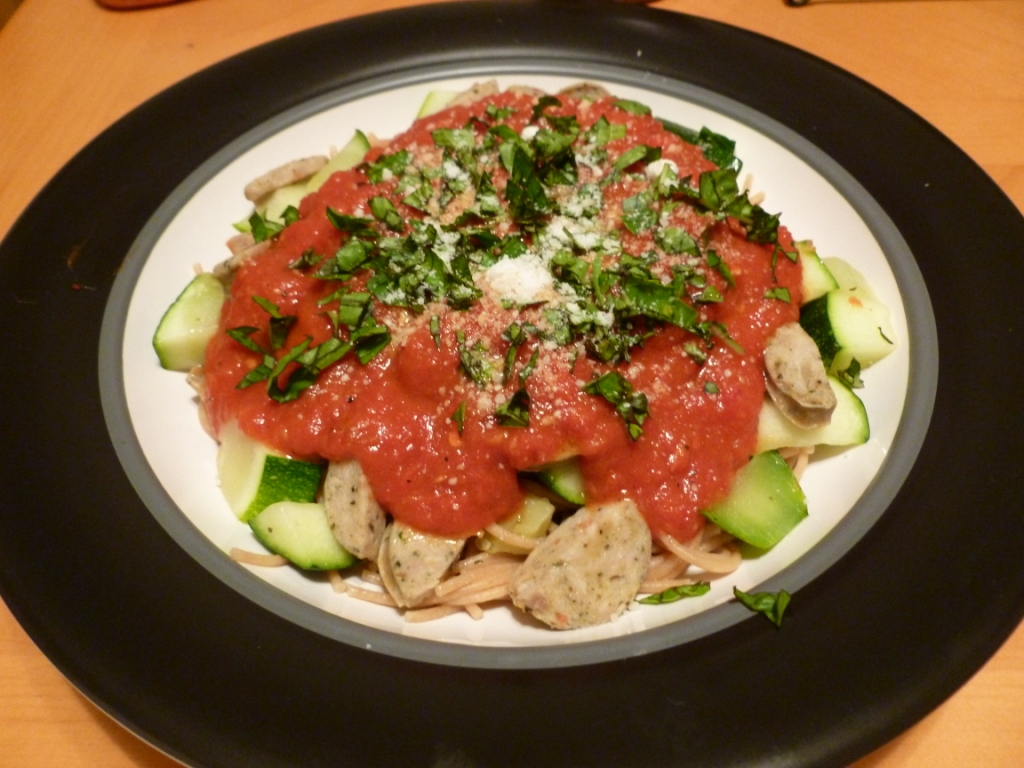
Those skins at the top sure don't look too appetizing, so they go to the compost bin, while we go on to making this into a meal. The sauce is yummy enough on its own that you could use it with noodles if you wanted a basic spaghetti marinara. We wanted to fill it out more into a full meal, so we added a couple cut-up links of chicken sausage, plus some chopped zucchini that we just sauteed in olive oil. Put all that together on top of some spaghetti noodles, grate some parmesan cheese and sprinkle on some fresh basil, and that's a hearty dinner.
Spaghetti with red sauce is never going to earn any Michelin stars or make it into a fancy French cookbook. But it's delicious comfort food, and sometimes it's just what you feel like. We've long felt that food doesn't need to be fancy as long as it's made from quality ingredients. This is a perfect example. We know that the tomatoes, onions, garlic, carrots, zucchini and herbs are grown in a manner we agree with, because we grew them. And short of making our own sausage (eww) or making our own pasta (time consuming), this is about as close to an entirely homegrown meal as you can get. We may have taken some inspiration from a recipe we found online, but this really was a meal we grew ourselves. Not just from farm to fork, we took this from seed to sauce!
This has particularly been the case recently, as our planned canning tomatoes have come in bit by bit rather than in one giant harvest. It seems we never have enough at one time to can up, yet if we try to wait for more to ripen, the first few will start to go bad. So why not make up a batch of garden-fresh tomato sauce, not to save, but to eat right away? A tasty sauce, inspired by this find on the internet - roasted tomato sauce from the "Sweet Pea Chef" blog.
We started with two pounds of our sauce tomatoes, romas and a variety called agro. Both of these tend to be meatier than a regular slicing tomato, so you don't end up with a bunch of watery goosh when you cook them. We opted to use some of our older ones as well, just cutting off any parts that looked or felt a bit past their prime. These we cut in half, and placed into sprayed baking dishes, along with a roughly chopped onion, several cloves of smashed garlic, and a couple cut-up carrots (they were small ones). As an added bonus, every single one of those ingredients was grown by us in our own backyard!
We drizzled the pans with a hearty amount of olive oil, then salted, peppered, and threw them into a 350 degree oven for about an hour and fifteen minutes. Hey, we said it was simple; we never said anything about quick! After an hour, the house began to fill with the aromas of roasting tomatoes, and by time we pulled them out, some of the veggies were just starting to blacken a bit and caramelize, like this.
Now you have to resist eating the lovely roasted tomatoes on their own - remember, we want a sauce here. And this is another time where an odd little kitchen tool really comes in handy. Sure, you could blend up the vegetables and probably get a good, smooth sauce. But if you use a food mill, it will separate the slightly tough skins from the now-softened meat of the tomatoes. No tomato skins getting stuck in your teeth, they all get caught in the top of the food mill! Either way, the whole pan's worth - tomatoes, onions, garlic, and carrots - all get pureed through the food mill.
Those skins at the top sure don't look too appetizing, so they go to the compost bin, while we go on to making this into a meal. The sauce is yummy enough on its own that you could use it with noodles if you wanted a basic spaghetti marinara. We wanted to fill it out more into a full meal, so we added a couple cut-up links of chicken sausage, plus some chopped zucchini that we just sauteed in olive oil. Put all that together on top of some spaghetti noodles, grate some parmesan cheese and sprinkle on some fresh basil, and that's a hearty dinner.
Spaghetti with red sauce is never going to earn any Michelin stars or make it into a fancy French cookbook. But it's delicious comfort food, and sometimes it's just what you feel like. We've long felt that food doesn't need to be fancy as long as it's made from quality ingredients. This is a perfect example. We know that the tomatoes, onions, garlic, carrots, zucchini and herbs are grown in a manner we agree with, because we grew them. And short of making our own sausage (eww) or making our own pasta (time consuming), this is about as close to an entirely homegrown meal as you can get. We may have taken some inspiration from a recipe we found online, but this really was a meal we grew ourselves. Not just from farm to fork, we took this from seed to sauce!
Thursday, July 12, 2012
Enchilada Sauce - a Tasty Labor of Love
Some people advocate for cooking at home because it saves you money versus dining out or buying prepared food. Other times it may cost more but the ability to control ingredients and preparation lets you know that you're making something that's tastier or better for you. And every once in a while, neither one of these is necessarily the case, but you cook it yourself because it's just so crazy fun. The homemade enchilada sauce we made tonight comes pretty close to falling into that third category.
Of course, our sauce didn't have a bunch of preservatives in it like the canned stuff does, so it probably was just a bit healthier. And in our humble opinion, the flavor did outdo storebought. But the main appeal, despite how laborious it was to make, was the fun of the process. So, if you want to make a delicious sauce that costs at least twice what they charge at the grocery store, clear a few hours from your schedule and follow along!
The first step is to collect some dried chile peppers. You can grow and dry these yourself; and with two dozen poblano and anahiem pepper plants in our garden, it's pretty possible that we'll try this after this year's harvest. But for now we needed to buy some. We got ours at Allspice in Des Moines, but another good option would be a Hispanic food store like you can find in many cities. We selected three good specimens of ancho (dried poblano) and New Mexico. We put these on a sheet pan and roasted them in the oven at 350 degrees for about 10 minutes. Once the peppers became fragrant, we knew it was time to pull them out.
Peppers keep most of their heat in the seeds and interior webs, so the next step is to cut them up and remove all the "guts." We want our sauce to have some kick, but these peppers have enough in the fruit that we don't need the seeds. The remaining pieces of pepper were chopped up and tossed in a bowl then covered with boiling water. We let this sit for about an hour to let the peppers really rehydrate.
After an hour the peppers had softened up, so we put them in the blender, along with some of the water they'd been steeping in. We didn't end up using all the water: just enough to get a good smooth, slightly runny consistency. Be careful at this stage not to touch your eyes since you will likely have plenty of capsacin on your fingers.
This still isn't sauce though, since it only has the one note of the peppers. To add a little bit more depth, we sauteed a chopped onion and three cloves of garlic in three tablespoons of butter. After it had all softened, we added a few tablespoons of flour to form a kind-of roux (a flour-butter mixture that thickens liquids). After the roux had cooked for a few minutes to remove the flour flavor, we poured in the blended peppers, a teaspoon each of cumin and Mexican oregano, plus a teaspoon and a half of salt. Again, we simmered the mixture for a while to blend all the flavors, then literally blended it to get it smooth!
In the end, we had about a quart of enchilada sauce. It only took an hour and a half to make it all, and it cost nearly $5 in peppers, but man oh man was it delicious.
We used it to make a huge platter of vegetarian enchiladas. We filled tortillas with a mixture of organic black beans, locally grown sweet corn, and sauteed green peppers, doused them in the sauce and baked them until everything had warmed up. They looked great!
And they tasted fantastic too. Greg could probably eat Mexican food every night, but this batch of enchiladas seemed superlatively satisfying. It's hard to say if it's because the sauce was so tasty or just so much fun to make, but by the end of dinner we sure were glad we'd done it.
Yum!
This post has been shared with Simple Lives Thursday.
Of course, our sauce didn't have a bunch of preservatives in it like the canned stuff does, so it probably was just a bit healthier. And in our humble opinion, the flavor did outdo storebought. But the main appeal, despite how laborious it was to make, was the fun of the process. So, if you want to make a delicious sauce that costs at least twice what they charge at the grocery store, clear a few hours from your schedule and follow along!
The first step is to collect some dried chile peppers. You can grow and dry these yourself; and with two dozen poblano and anahiem pepper plants in our garden, it's pretty possible that we'll try this after this year's harvest. But for now we needed to buy some. We got ours at Allspice in Des Moines, but another good option would be a Hispanic food store like you can find in many cities. We selected three good specimens of ancho (dried poblano) and New Mexico. We put these on a sheet pan and roasted them in the oven at 350 degrees for about 10 minutes. Once the peppers became fragrant, we knew it was time to pull them out.
Peppers keep most of their heat in the seeds and interior webs, so the next step is to cut them up and remove all the "guts." We want our sauce to have some kick, but these peppers have enough in the fruit that we don't need the seeds. The remaining pieces of pepper were chopped up and tossed in a bowl then covered with boiling water. We let this sit for about an hour to let the peppers really rehydrate.
After an hour the peppers had softened up, so we put them in the blender, along with some of the water they'd been steeping in. We didn't end up using all the water: just enough to get a good smooth, slightly runny consistency. Be careful at this stage not to touch your eyes since you will likely have plenty of capsacin on your fingers.
This still isn't sauce though, since it only has the one note of the peppers. To add a little bit more depth, we sauteed a chopped onion and three cloves of garlic in three tablespoons of butter. After it had all softened, we added a few tablespoons of flour to form a kind-of roux (a flour-butter mixture that thickens liquids). After the roux had cooked for a few minutes to remove the flour flavor, we poured in the blended peppers, a teaspoon each of cumin and Mexican oregano, plus a teaspoon and a half of salt. Again, we simmered the mixture for a while to blend all the flavors, then literally blended it to get it smooth!
In the end, we had about a quart of enchilada sauce. It only took an hour and a half to make it all, and it cost nearly $5 in peppers, but man oh man was it delicious.
We used it to make a huge platter of vegetarian enchiladas. We filled tortillas with a mixture of organic black beans, locally grown sweet corn, and sauteed green peppers, doused them in the sauce and baked them until everything had warmed up. They looked great!
And they tasted fantastic too. Greg could probably eat Mexican food every night, but this batch of enchiladas seemed superlatively satisfying. It's hard to say if it's because the sauce was so tasty or just so much fun to make, but by the end of dinner we sure were glad we'd done it.
Yum!
This post has been shared with Simple Lives Thursday.
Friday, July 6, 2012
June Harvest Update + a recipe!
Much as we love our garden, it doesn't seem that Mother Nature has been too interested in helping us out with it. It has been phenomenally hot and dry all through June and thus far into July without much relief in sight. According to the Iowa Environmental Mesonet, we received 2.08 inches of water in June, versus the average of 4.94. So we've been busy watering our plants, making sure to do so away from peak hours so it has some chance of soaking in.
We were concerned that the dry spring, coupled with the excessive heat, would limit our harvests of spring crops but thankfully that hasn't been the case. June was the month of broccoli, with nearly every plant we started producing a full-sized head plus several side shoots. Plus we continued to harvest our baby spinach and began picking snow peas and kale.
In June we harvested:
14.3 ounces of the lovely kale shown above
1 lb, 0.4 ounces of spinach, the end of the spring crop
2 lb 15.4 ounces of snow or sugar snap peas
and...
a whopping 7 lb 3.0 ounces more broccoli!
We love broccoli, but that's a lot of steamed broccoli, even for us. So, on a day where you walk into the backyard and realize, we need to pick those three heads of broccoli right now or else they will bolt, what do you do?
You make broccoli-raisin salad, of course! Odds are you've had broccoli salad a time or two, at a picnic, a salad bar or a potluck get-together. Well, we just love the stuff, so it was a no-brainer way to use a bunch of broccoli fresh out of the garden. But we make ours just a touch differently from the standard recipe. Here's how we do it.
Naturally, we start with that broccoli, chopped up into florets. Since the size of the heads varies, we use 2-3, or until it nearly fills our big 8 cup measuring cup. Some people aren't fond of using the stalks, but if it's fresh they're not usually too woody. So, while Greg chopped them up, Stacia...
Whipped up a quick dressing made of 1 cup mayonnaise, 2 tablespoons balsamic vinegar, and 2 teaspoons sugar. This is often done with regular white vinegar but using balsamic really adds a little more depth of flavor.
And now, brace yourselves for the blasphemous part. We don't add any bacon. Don't worry - we, along with the rest of the country, do enjoy bacon, but in this dish it can be a bit overpowering. The upside is that means no frying, so this is truly a no-cook salad. All you have to do now is toss the rest of the ingredients with the dressing.
Those ingredients are: the chopped broccoli, 1/2 cup raisins, some chopped onion if you have it (we didn't so we left it out; no big deal), and 1/4 cup sunflower seeds. Sunflower seeds get you the protein part of the meal that's traditionally done with bacon, but this is a much less assertive flavor. Toss it all together, and let it marinade for about 4 hours, or at least as many as you can resist eating it!
So there you have it! Next time you're faced with the wonderful quandary of how to use seven pounds of homegrown broccoli, try making this salad. It can go with almost anything, but we usually end up just munching on it as a snack and it's gone before we know it.
Hopefully we get a little bit of rain to help our plants out in the next month. It should be an exciting time, as we may start to harvest tomatoes and peppers, among other things. Using up a glut of either of those is just as fun, so we'll keep our fingers crossed that we get one!
Friday, April 13, 2012
Eating our Pig - Seared Pork Chops
You may recall our excitement when we purchased a half hog from a local producer, Crooked Gap Farm, back in January. We talked all about what cuts we were getting, what a great deal it was, and how important it is to us to be able to support a small farmer. Then we haven't mentioned it in over three months. Well, don't worry, we've been eating from our half hog, just not necessarily writing about it. That can end today as we document what turned out to be a delicious and mostly local meal.
To start, we thawed out a package of bone-in Iowa Chops. These are a really nice cut, but it sometimes feels like we're stuck in a rut when it comes to pork chops. For some reason we always default to a bare-bones salt and pepper seasoned chop with a plain pan gravy. With nice pork, this can be tasty, but we figured we ought to know enough about cooking to be able to jazz it up a bit.
With that in mind, we headed out to the garden to see if anything was close to ripe yet. In our lettuce/spinach/radishes box, we were met with this kind of growth.
Those guys in the middle are the radishes we first planted on March 10th. Some of them are almost there, but they're just not quite to size to pick. But, did you know you can eat radish greens, too? That meant we got to have...
Our FIRST HARVEST of the year!!!
With a pair of scissors,we snipped off a leaf or two from each of the biggest and healthiest looking plants. As you can see, this didn't exactly amount to much - 1 ounce altogether. That's fine, since these were always intended to be a garnish or a side, and not a main part of the meal. But keep in mind if you do try radish or any other kind of green that they do cook down a lot, so this one ounce got pretty small by time we ate.
Also, if you have a batch of radishes with their tops, you might feel the leaves and wonder how on earth anyone could eat them. They're very prickly, which would probably be painful to eat raw. Rest assured, once they're cooked, those little spines are no longer discernible, and the greens feel just like spinach or kale.
So we had a vision of pork chops with a small batch of radish greens on top. From there, we just brainstormed with what was available, and what we've enjoyed in the past to make our "recipe." We ended up making pan-seared rosemary pork chops with sauteed radish greens and a sherry demi glace on a garlic cauliflower puree. If we ever open a restaurant, we'll certainly need to shorten that name! But though it sounds complicated, each piece is very simple and better yet, adaptable. Once you've got a few basic methods down, you won't even need a formal recipe. Let's get started!
Like so (but covered), for about 10 minutes or until the cauliflower pieces felt soft when poked with a fork.
Meanwhile, we got the pork out of the fridge, and sprinkled it with salt, pepper, and a lot of dry rosemary. Sadly, our rosemary plant from last year didn't survive a winter of neglect indoors, otherwise we might have had fresh rosemary available. We'll have to hope we're more responsible this year.
It's actually good to let meat get to room temperature before you cook it, so we kept these guys on the counter for a bit while we got the cauliflower up to a boil. Aren't they beautiful chops?
Next it was time for the main action of the meal - the searing. The concept behind searing is to cook the outsides of the meat at a pretty darn high temperature to seal the juices in, then finish the cooking process either in the oven, or in this case, on the cooktop. You can brown cuts of meat okay in a regular nonstick pan, but for a real sear, we love our All-Clad. Basically, you get your pan plenty hot and throw in some sort of fat/oil - in this case a tablespoon-sized pat of butter per side. When you put the chops in, you should hear a nice sizzle.
The chops will probably stick where they are initially, which might freak you out a bit if you've never used a "non-nonstick" pan before. Don't worry, once each side sears properly, it should release and allow you to flip it. Sometimes it will need a little nudge, but it shouldn't end up being stuck too badly. If memory serves, this took about 3-4 minutes on a side.
By this time the cauliflower was nice and soft, so we pureed it in the blender. We didn't use all of the stock from the pot - just poured in enough to get the right consistency, little by little. It didn't take much blending to get the cauliflower very smooth.
Keep in mind that hot liquids like to expand/splatter when you blend them, so be sure to hold down the top of the blender as you run it. We like to throw a towel over the lid, and hold down on that, so any escaping liquid gets the towel and not your hands (ouch!).
So, a sprinkle of salt and the cauliflower puree was all set; the chops had now been seared on both sides, but the insides were probably still a touch rare. We pulled them out of the pan and deglazed it with a little bit of sherry wine (maybe a quarter cup - it was whatever we had left in the bottle). Here it's nice to grab a whisk and mix in any of the little tasty browned bits from the searing process to get them into the sauce. We had some red onion handy so we minced that and added it, plus enough stock to create a nice amount of sauce.
With that made and mixed up, we put the chops back in and simmered them a bit longer.
Again, with the lid on, when we werent't taking pictures. This took about another 5 minutes maybe.
Then it was time for our garden contribution - the radish greens! These are so easy. Heat some olive oil in a pan, throw in your greens (we tore them a bit to get better sized pieces), and stir them around. But keep an eye on them! It will literally take less than a minute or so to get them cooked down, and then you need to get them out of the pan to keep them from shrinking down to nothing.
These looked about ready. The last step was to add a little bit of a cornstarch slurry (corn starch plus a bit of cold water) to our pan sauce to thicken it up. You can use roux (flour and butter) if you have it, to feel more chef-y, but either method yields the same result. Our sauce was just a touch too thin, so a very small amount was needed to keep it from running everywhere.
Then it was time to plate! We put a good-sized dollop of the cauliflower puree in the center of the plate, placed a pork chop on top, and arranged the greens on the chop. We tried to be a little artsy, drizzling the sauce around the edge of the plate rather than on top, but it all gets mixed up when you eat anyway.
By the end of the process (forgiving the amateur photographer), it looked pretty fancy!
And it tasted amazing! It helps when you start with great ingredients, like woodland pastured pork, and home grown garden greens, but what a tasty dinner! We had just enough garlic to kick up the cauliflower puree, the rosemary flavor had seared into the perfectly cooked pork chop, and the radish greens added a touch of earthiness and bite. The demi glace was phenomenal; adding a little sherry to a plain pan gravy sure added a depth of flavor we don't always see in our sauces. Paired with a tasty Four Vines Naked Chardonnay, it made one delicious meal.
And that's part of the fun with cooking with fresh ingredients. We had no idea what we were going to do with our chops to liven them up, so we played with what we had. A puree under a cut of meat is a bit of a modern cooking cliche, but hey, it works. We've done it with sweet potatoes or turnips before, under anything from salmon to chicken. Once you know how to sear a piece of meat and either finish it in the sauce or in the oven, you can make pretty much anything. If it's in season, fresh, or looks great, why not give it a try and see if you like the result. It might not always work out, but when it does, it can be a hit right out of the park!
To start, we thawed out a package of bone-in Iowa Chops. These are a really nice cut, but it sometimes feels like we're stuck in a rut when it comes to pork chops. For some reason we always default to a bare-bones salt and pepper seasoned chop with a plain pan gravy. With nice pork, this can be tasty, but we figured we ought to know enough about cooking to be able to jazz it up a bit.
With that in mind, we headed out to the garden to see if anything was close to ripe yet. In our lettuce/spinach/radishes box, we were met with this kind of growth.
Those guys in the middle are the radishes we first planted on March 10th. Some of them are almost there, but they're just not quite to size to pick. But, did you know you can eat radish greens, too? That meant we got to have...
Our FIRST HARVEST of the year!!!
With a pair of scissors,we snipped off a leaf or two from each of the biggest and healthiest looking plants. As you can see, this didn't exactly amount to much - 1 ounce altogether. That's fine, since these were always intended to be a garnish or a side, and not a main part of the meal. But keep in mind if you do try radish or any other kind of green that they do cook down a lot, so this one ounce got pretty small by time we ate.
Also, if you have a batch of radishes with their tops, you might feel the leaves and wonder how on earth anyone could eat them. They're very prickly, which would probably be painful to eat raw. Rest assured, once they're cooked, those little spines are no longer discernible, and the greens feel just like spinach or kale.
So we had a vision of pork chops with a small batch of radish greens on top. From there, we just brainstormed with what was available, and what we've enjoyed in the past to make our "recipe." We ended up making pan-seared rosemary pork chops with sauteed radish greens and a sherry demi glace on a garlic cauliflower puree. If we ever open a restaurant, we'll certainly need to shorten that name! But though it sounds complicated, each piece is very simple and better yet, adaptable. Once you've got a few basic methods down, you won't even need a formal recipe. Let's get started!
First we chopped up about a half head of cauliflower. It's a little early yet for these to be in season in Iowa (except maybe with the aid of greenhouses?), so it's from California. We also smashed a few garlic cloves with the side of a knife, which is always fun. And since we don't have any homemade stock at the moment, we used some good boxed stuff. We threw the pieces into a pot, poured in just enough of a stock and water mix to cover them, and simmered.
Like so (but covered), for about 10 minutes or until the cauliflower pieces felt soft when poked with a fork.
Meanwhile, we got the pork out of the fridge, and sprinkled it with salt, pepper, and a lot of dry rosemary. Sadly, our rosemary plant from last year didn't survive a winter of neglect indoors, otherwise we might have had fresh rosemary available. We'll have to hope we're more responsible this year.
It's actually good to let meat get to room temperature before you cook it, so we kept these guys on the counter for a bit while we got the cauliflower up to a boil. Aren't they beautiful chops?
Next it was time for the main action of the meal - the searing. The concept behind searing is to cook the outsides of the meat at a pretty darn high temperature to seal the juices in, then finish the cooking process either in the oven, or in this case, on the cooktop. You can brown cuts of meat okay in a regular nonstick pan, but for a real sear, we love our All-Clad. Basically, you get your pan plenty hot and throw in some sort of fat/oil - in this case a tablespoon-sized pat of butter per side. When you put the chops in, you should hear a nice sizzle.
The chops will probably stick where they are initially, which might freak you out a bit if you've never used a "non-nonstick" pan before. Don't worry, once each side sears properly, it should release and allow you to flip it. Sometimes it will need a little nudge, but it shouldn't end up being stuck too badly. If memory serves, this took about 3-4 minutes on a side.
By this time the cauliflower was nice and soft, so we pureed it in the blender. We didn't use all of the stock from the pot - just poured in enough to get the right consistency, little by little. It didn't take much blending to get the cauliflower very smooth.
Keep in mind that hot liquids like to expand/splatter when you blend them, so be sure to hold down the top of the blender as you run it. We like to throw a towel over the lid, and hold down on that, so any escaping liquid gets the towel and not your hands (ouch!).
So, a sprinkle of salt and the cauliflower puree was all set; the chops had now been seared on both sides, but the insides were probably still a touch rare. We pulled them out of the pan and deglazed it with a little bit of sherry wine (maybe a quarter cup - it was whatever we had left in the bottle). Here it's nice to grab a whisk and mix in any of the little tasty browned bits from the searing process to get them into the sauce. We had some red onion handy so we minced that and added it, plus enough stock to create a nice amount of sauce.
With that made and mixed up, we put the chops back in and simmered them a bit longer.
Again, with the lid on, when we werent't taking pictures. This took about another 5 minutes maybe.
Then it was time for our garden contribution - the radish greens! These are so easy. Heat some olive oil in a pan, throw in your greens (we tore them a bit to get better sized pieces), and stir them around. But keep an eye on them! It will literally take less than a minute or so to get them cooked down, and then you need to get them out of the pan to keep them from shrinking down to nothing.
These looked about ready. The last step was to add a little bit of a cornstarch slurry (corn starch plus a bit of cold water) to our pan sauce to thicken it up. You can use roux (flour and butter) if you have it, to feel more chef-y, but either method yields the same result. Our sauce was just a touch too thin, so a very small amount was needed to keep it from running everywhere.
Then it was time to plate! We put a good-sized dollop of the cauliflower puree in the center of the plate, placed a pork chop on top, and arranged the greens on the chop. We tried to be a little artsy, drizzling the sauce around the edge of the plate rather than on top, but it all gets mixed up when you eat anyway.
By the end of the process (forgiving the amateur photographer), it looked pretty fancy!
And it tasted amazing! It helps when you start with great ingredients, like woodland pastured pork, and home grown garden greens, but what a tasty dinner! We had just enough garlic to kick up the cauliflower puree, the rosemary flavor had seared into the perfectly cooked pork chop, and the radish greens added a touch of earthiness and bite. The demi glace was phenomenal; adding a little sherry to a plain pan gravy sure added a depth of flavor we don't always see in our sauces. Paired with a tasty Four Vines Naked Chardonnay, it made one delicious meal.
And that's part of the fun with cooking with fresh ingredients. We had no idea what we were going to do with our chops to liven them up, so we played with what we had. A puree under a cut of meat is a bit of a modern cooking cliche, but hey, it works. We've done it with sweet potatoes or turnips before, under anything from salmon to chicken. Once you know how to sear a piece of meat and either finish it in the sauce or in the oven, you can make pretty much anything. If it's in season, fresh, or looks great, why not give it a try and see if you like the result. It might not always work out, but when it does, it can be a hit right out of the park!
Thursday, December 15, 2011
What it All Boils Down To
Mo' fat, mo' flavor.
These four simple words, spoken by Chef Ryan Dowie, quickly became a catchphrase of sorts for those of us studying under him. If he threw a full stick of butter into a pot during class, a chorus of "mo' fat, mo' flavor" would quickly resound from the audience. But maybe we're getting ahead of ourselves...
A good starting point would be to introduce Chef Dowie and explain how the heck we even know who he is. As far as we last knew, he's the head chef at the Waterfront Restaurant in Des Moines, and a part-time instructor at the Iowa Culinary Institute, part of the Des Moines Area Community College. DMACC, as it's known, has a fairly highly regarded culinary program, to the extent that there's a waiting list to even get in to the degree program. Fortunately, they also offered a one-semester seminar course to casual, "non-career" chefs. Last fall, Greg took the class.
Over the course of the semester, we moved from the basics, through soups, salads and breads to the various meats and more, learning the proper preparations for each. But one of the most lasting lessons occurred in the early weeks of the class, and it came in handy again tonight.
Any ideas what we're making out of this? Let's see: bay leaves, pepper, thyme, celery, onions, garlic, carrots, and... a bunch of empty shrimp shells? That's right, baby, we're making stock!
Homemade stock is great - it's as versatile as the boxed stuff, but you get to control exactly what goes into it, so no MSG, preservatives, or other junk. Plus it tastes so much better, and it's a breeze to make. We'll often make chicken stock with leftover carcasses; shrimp is a little less common, but we had been saving shells from several meals-worth of shrimp. Shells come free with the shrimp, so it seems a shame not to use them for something.
The first step is to chop up the vegetables. The good thing here is that the chop can be pretty coarse, since it will be simmering for quite a while (even more so with chicken and beef).
Some folks will just throw these into a stockpot with boiling water, but we prefer to sautee them about 5 minutes or so first. It releases some of the flavors, and it's how Chef Dowie taught it, so who are we to argue? We sauteed in butter, but you could use an oil if you prefer.
We also sauteed the shells for a bit, to start releasing some of their flavorful oils.
We did this for maybe a minute or two, then added two quarts of water, plus the 2 bay leaves and a small palmful each of pepper and thyme. We don't add any salt at this point, because it's easy to overdo it. As the stock cooks, liquid evaporates off, so the salt could get really concentrated. It's best to just salt at the very end, once the stock is pretty much done.
Then comes the really easy part of making stock. Bring it to a boil, lower it to a simmer, then go watch an episode of your favorite TV show! Well, you can do whatever you like to fill that time, but you're free for about an hour while the stock does its thing, pulling flavor from the ingredients into the liquid.
About this time, you'll probably start to notice that your stock is becoming fragrant, and has taken on a much richer color. Yum! Seeing soup in your future? Only a few steps to go. Now we need to filter out the pieces. All their flavor has gone into the liquid by now, so they're pretty much used up (and ready for the compost bin). We strained through a cheesecloth and a mesh strainer. Be sure the bowl you're straining into is big enough to hold all the liquid.
And there it is. Just over an hour, and we've gone from discarded shells to a lovely shrimp stock. We're not planning to use it immediately, so we poured ours into a couple of freezer containers for another day.
Now we're all set to make a shrimp bisque sometime, possibly a gumbo, or maybe some sort of seafood risotto. The possibilities are almost limitless. And it'll feel good to use, knowing we made it ourselves.
This same basic procedure will work for any sort of stock, though the simmering times will vary. Veggie is the shortest, from about 30 to 45 minutes, chicken should go for a few hours, and beef is kind of an all day project. We hope you'll keep this idea in mind next time you're peeling shrimp, or have some leftover bones!
These four simple words, spoken by Chef Ryan Dowie, quickly became a catchphrase of sorts for those of us studying under him. If he threw a full stick of butter into a pot during class, a chorus of "mo' fat, mo' flavor" would quickly resound from the audience. But maybe we're getting ahead of ourselves...
A good starting point would be to introduce Chef Dowie and explain how the heck we even know who he is. As far as we last knew, he's the head chef at the Waterfront Restaurant in Des Moines, and a part-time instructor at the Iowa Culinary Institute, part of the Des Moines Area Community College. DMACC, as it's known, has a fairly highly regarded culinary program, to the extent that there's a waiting list to even get in to the degree program. Fortunately, they also offered a one-semester seminar course to casual, "non-career" chefs. Last fall, Greg took the class.
Over the course of the semester, we moved from the basics, through soups, salads and breads to the various meats and more, learning the proper preparations for each. But one of the most lasting lessons occurred in the early weeks of the class, and it came in handy again tonight.
Any ideas what we're making out of this? Let's see: bay leaves, pepper, thyme, celery, onions, garlic, carrots, and... a bunch of empty shrimp shells? That's right, baby, we're making stock!
Homemade stock is great - it's as versatile as the boxed stuff, but you get to control exactly what goes into it, so no MSG, preservatives, or other junk. Plus it tastes so much better, and it's a breeze to make. We'll often make chicken stock with leftover carcasses; shrimp is a little less common, but we had been saving shells from several meals-worth of shrimp. Shells come free with the shrimp, so it seems a shame not to use them for something.
The first step is to chop up the vegetables. The good thing here is that the chop can be pretty coarse, since it will be simmering for quite a while (even more so with chicken and beef).
Some folks will just throw these into a stockpot with boiling water, but we prefer to sautee them about 5 minutes or so first. It releases some of the flavors, and it's how Chef Dowie taught it, so who are we to argue? We sauteed in butter, but you could use an oil if you prefer.
We also sauteed the shells for a bit, to start releasing some of their flavorful oils.
We did this for maybe a minute or two, then added two quarts of water, plus the 2 bay leaves and a small palmful each of pepper and thyme. We don't add any salt at this point, because it's easy to overdo it. As the stock cooks, liquid evaporates off, so the salt could get really concentrated. It's best to just salt at the very end, once the stock is pretty much done.
Then comes the really easy part of making stock. Bring it to a boil, lower it to a simmer, then go watch an episode of your favorite TV show! Well, you can do whatever you like to fill that time, but you're free for about an hour while the stock does its thing, pulling flavor from the ingredients into the liquid.
About this time, you'll probably start to notice that your stock is becoming fragrant, and has taken on a much richer color. Yum! Seeing soup in your future? Only a few steps to go. Now we need to filter out the pieces. All their flavor has gone into the liquid by now, so they're pretty much used up (and ready for the compost bin). We strained through a cheesecloth and a mesh strainer. Be sure the bowl you're straining into is big enough to hold all the liquid.
And there it is. Just over an hour, and we've gone from discarded shells to a lovely shrimp stock. We're not planning to use it immediately, so we poured ours into a couple of freezer containers for another day.
Now we're all set to make a shrimp bisque sometime, possibly a gumbo, or maybe some sort of seafood risotto. The possibilities are almost limitless. And it'll feel good to use, knowing we made it ourselves.
This same basic procedure will work for any sort of stock, though the simmering times will vary. Veggie is the shortest, from about 30 to 45 minutes, chicken should go for a few hours, and beef is kind of an all day project. We hope you'll keep this idea in mind next time you're peeling shrimp, or have some leftover bones!
Saturday, December 10, 2011
Thinking Outside the (Big)Box
If you were to take a walk through the produce department of your local grocery store, you'd probably find neatly stacked (I would know, I used to stack them -Greg), perfectly uniform towers of various different fruits and vegetables. Apples and oranges, carrots and cucumbers. But unless you're at a specialty grocer, you might not find something that looks like this:
Any ideas what this guy could be? Well, don't feel bad if you don't know; we hadn't heard of delicata squash either until our friend Sarah did a squash taste test a few weeks back and declared delicata the winner. The delicata is frequently referred to as a winter squash, like butternut or acorn, but it's actually more closely related to the zucchini. It came highly recommended, and like other squashes is chock-full of fiber and nutrients like potassium, magnesium and vitamins B & C. With this knowledge in mind, we made a point to keep an eye out for delicata as we shopped.
Fortunately for us, Gateway Market in Des Moines frequently sources produce from local suppliers, and we were able to pick up a few delicata squash that were grown in Murray, Iowa, just about an hour from home. You might remember our adventures in squash cooking haven't been terribly reliable lately, so we decided to keep things simple this time around. It doesn't get much simpler or more classic than slicing in half and removing seeds, throwing in a few pats of butter and some brown sugar, then roasting at 350 F for about an hour. And the result looks so delicious, doesn't it?
Once the squash were cooked, Stacia scooped out the flesh while Greg pan-seared up a couple of pork chops with some rosemary and thyme and whipped up a quick pan sauce. Altogether, it made for a delicious, hearty dinner, perfect for a chilly December evening.
This is one of the most exciting things about growing your own food or shopping locally grown produce. The variety is virtually endless, far beyond the handful of options that are commercially produced. If you go to the store, you'll find tomatoes, but if you leaf through a seed catalog, you can find literally hundreds of different kinds of tomatoes, all with different characteristics: size, shape, color, flavor, texture, etc. Growing food in the garden puts all those choices into your hands, for unrivaled culinary freedom. And you just might discover a flavorful new squash you've never tried before.
When you're able to find such interesting, high-quality ingredients, a simple preparation can lead to a really tasty meal!
Any ideas what this guy could be? Well, don't feel bad if you don't know; we hadn't heard of delicata squash either until our friend Sarah did a squash taste test a few weeks back and declared delicata the winner. The delicata is frequently referred to as a winter squash, like butternut or acorn, but it's actually more closely related to the zucchini. It came highly recommended, and like other squashes is chock-full of fiber and nutrients like potassium, magnesium and vitamins B & C. With this knowledge in mind, we made a point to keep an eye out for delicata as we shopped.
Fortunately for us, Gateway Market in Des Moines frequently sources produce from local suppliers, and we were able to pick up a few delicata squash that were grown in Murray, Iowa, just about an hour from home. You might remember our adventures in squash cooking haven't been terribly reliable lately, so we decided to keep things simple this time around. It doesn't get much simpler or more classic than slicing in half and removing seeds, throwing in a few pats of butter and some brown sugar, then roasting at 350 F for about an hour. And the result looks so delicious, doesn't it?
Once the squash were cooked, Stacia scooped out the flesh while Greg pan-seared up a couple of pork chops with some rosemary and thyme and whipped up a quick pan sauce. Altogether, it made for a delicious, hearty dinner, perfect for a chilly December evening.
This is one of the most exciting things about growing your own food or shopping locally grown produce. The variety is virtually endless, far beyond the handful of options that are commercially produced. If you go to the store, you'll find tomatoes, but if you leaf through a seed catalog, you can find literally hundreds of different kinds of tomatoes, all with different characteristics: size, shape, color, flavor, texture, etc. Growing food in the garden puts all those choices into your hands, for unrivaled culinary freedom. And you just might discover a flavorful new squash you've never tried before.
When you're able to find such interesting, high-quality ingredients, a simple preparation can lead to a really tasty meal!
Subscribe to:
Posts (Atom)