Showing posts with label herbs. Show all posts

Sunday, April 7, 2013

Signs of Spring

We'd almost forgotten what it felt like, but we finally had a nice weekend to get out into the garden! As we've mentioned before, we've gotten a good start on seedlings under the growlight, but we've hardly seen the outdoor garden beds since last fall. So today we headed out back to do a little maintenance and just generally see how things were going. And when we got there, we came upon a few surprises.


That's garlic, popping up through the leaf mulch we put down when we planted last October. We planted 25 garlic bulbs and have spotted 17 sprouts so far. Some of them are already showing a lot of growth, so we'll just have to keep an eye on them until July or so when they'll be ready for harvest.


Next we wandered over to the strawberry bed and cleared off the mulch of straw that allowed them to overwinter. Strawberries can handle a bit of a frost, so even if we get a cold snap they should be okay without the straw. Most of the plants from last year look pretty good, but we've also got some new growth like you can see in the picture. This should be where we get our fruit this summer, so it's encouraging to see it doing well already.

While we were clearing straw, we also removed some from around the rosemary (a futile attempt to keep it alive over the winter). And there, we got some even bigger surprises.


It seems our parsley self-seeded when we left it in the ground at the end of last season.


And so did the oregano...


And apparently the chives! This was kind of an accident, since we simply ran out of time to pull all the plants before the winter arrived. So several boxes still had their crops in them by the late fall, when they went to seed. Sometime this spring, it appears those seeds sprouted, and with no work at all on our part, we have a head start on our herb bed. This is about as natural a gardening process as you can have!


Much less of a surprise was this scene: rhubarb starting to poke up out of the ground. This garden is our first time growing rhubarb, but in our zone it's a notoriously robust and hardy plant. Still, it's always a thrill to see that the roots that lay dormant all winter long survived and are starting to send up new growth.


Similarly for this guy - the very start of an asparagus sprout. Our asparagus is a regular green variety, not one of the purple hybrids, but for some reason it's starting off purple. Our recollection is that it did this last year as well before it eventually turned green, so we're not too worried. Last year we had to let all of our asparagus grow out to ferns undisturbed so it was able to store enough energy to last the winter. This year we should be able to harvest for a few weeks before we let it fern out. That makes seeing the first few tips all the more exciting, knowing they should lead to a harvest.

Now it really feels like the gardening season is starting in earnest! Have you started any plants, or seen any overwintered sprouts? This has to be one of the best times of the year.

Thursday, September 20, 2012

A Sauce of Our Own

One of the many perks of having a plot of fresh produce just outside your backdoor is how easy it is to cook simple, delicious meals. We both enjoy cooking, in pretty much all its forms. There are nights that we want to make something from a fancy recipe, and spend hours in the kitchen rolling roulades, whipping up demi glaces, and scads of other french-sounding culinary tasks. If we're in the right mood, that can make for a whole evening's entertainment. But other nights we just need a simple way to use some of our fresh garden produce.

This has particularly been the case recently, as our planned canning tomatoes have come in bit by bit rather than in one giant harvest. It seems we never have enough at one time to can up, yet if we try to wait for more to ripen, the first few will start to go bad.  So why not make up a batch of garden-fresh tomato sauce, not to save, but to eat right away? A tasty sauce, inspired by this find on the internet - roasted tomato sauce from the "Sweet Pea Chef" blog.


We started with two pounds of our sauce tomatoes, romas and a variety called agro. Both of these tend to be meatier than a regular slicing tomato, so you don't end up with a bunch of watery goosh when you cook them. We opted to use some of our older ones as well, just cutting off any parts that looked or felt a bit past their prime. These we cut in half, and placed into sprayed baking dishes, along with a roughly chopped onion, several cloves of smashed garlic, and a couple cut-up carrots (they were small ones). As an added bonus, every single one of those ingredients was grown by us in our own backyard!

We drizzled the pans with a hearty amount of olive oil, then salted, peppered, and threw them into a 350 degree oven for about an hour and fifteen minutes. Hey, we said it was simple; we never said anything about quick! After an hour, the house began to fill with the aromas of roasting tomatoes, and by time we pulled them out, some of the veggies were just starting to blacken a bit and caramelize, like this.


Now you have to resist eating the lovely roasted tomatoes on their own - remember, we want a sauce here. And this is another time where an odd little kitchen tool really comes in handy. Sure, you could blend up the vegetables and probably get a good, smooth sauce. But if you use a food mill, it will separate the slightly tough skins from the now-softened meat of the tomatoes. No tomato skins getting stuck in your teeth, they all get caught in the top of the food mill! Either way, the whole pan's worth - tomatoes, onions, garlic, and carrots - all get pureed through the food mill.


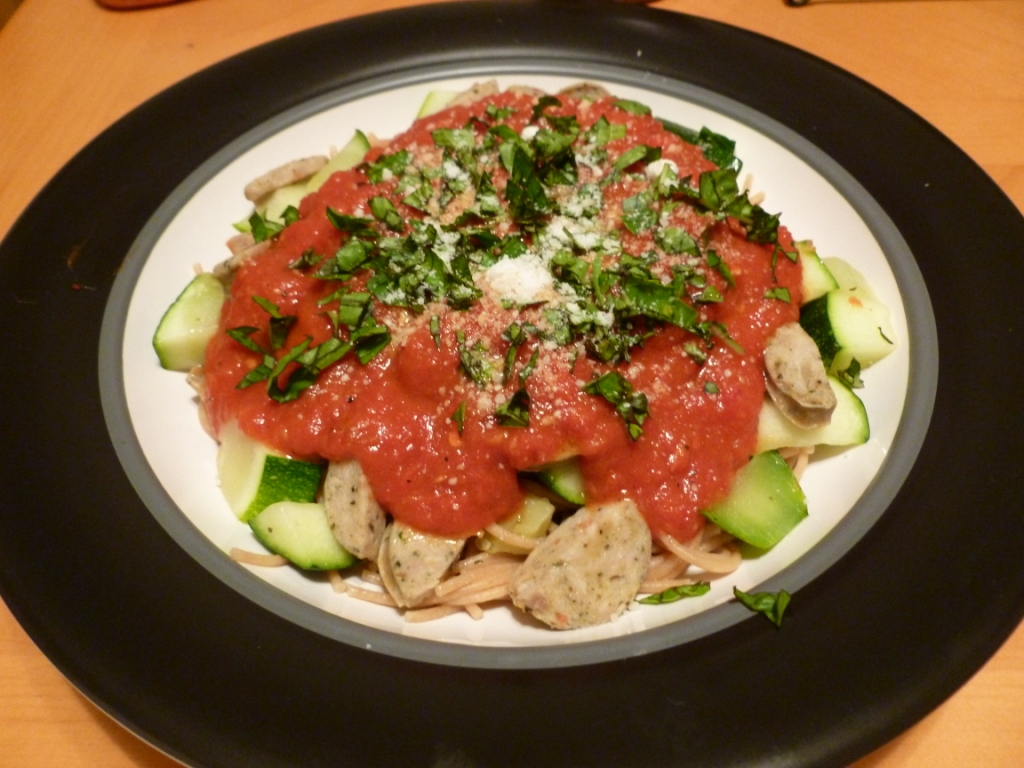
Those skins at the top sure don't look too appetizing, so they go to the compost bin, while we go on to making this into a meal. The sauce is yummy enough on its own that you could use it with noodles if you wanted a basic spaghetti marinara. We wanted to fill it out more into a full meal, so we added a couple cut-up links of chicken sausage, plus some chopped zucchini that we just sauteed in olive oil. Put all that together on top of some spaghetti noodles, grate some parmesan cheese and sprinkle on some fresh basil, and that's a hearty dinner.


Spaghetti with red sauce is never going to earn any Michelin stars or make it into a fancy French cookbook. But it's delicious comfort food, and sometimes it's just what you feel like. We've long felt that food doesn't need to be fancy as long as it's made from quality ingredients. This is a perfect example. We know that the tomatoes, onions, garlic, carrots, zucchini and herbs are grown in a manner we agree with, because we grew them. And short of making our own sausage (eww) or making our own pasta (time consuming), this is about as close to an entirely homegrown meal as you can get. We may have taken some inspiration from a recipe we found online, but this really was a meal we grew ourselves. Not just from farm to fork, we took this from seed to sauce!

Friday, June 29, 2012

Urban Farm Fresh Herbs

We've talked about our garden quite a bit on these pages, but there is still one garden we haven't made much mention of, and it's nearly as important as the main one: our herb garden. If you've ever bought fresh herbs at the grocery store, you can probably see how a few seed packets or started plants can save you lots of money in the long run. Every time we opened one of those $2-3 plastic packages of basil or cilantro, we've vowed that our new garden would have a dedicated space for herbs. And now we have one!


We planted ours in one of our now-standard raised beds, but kept this one to 4x4 square as opposed to our usual 4x8 shape. In this space, we have some of virtually all the herbs we most frequently use in our cooking. Chives, cilantro, oregano, parsley, sage, basil, and rosemary, plus a new one for us - Thai holy basil. Many of these we grew from seeds, but some of the others were slow to germinate so we bought started plants.


Rosemary in particular is a good one to buy at a garden store. Unlike most other herbs, rosemary is actually a perrenial, meaning it can come back year after year. In our climate the winters are too harsh to allow this, so you either have to start over each year, or bring the plant inside in a container until it warms up again. Which brings up another great point about herbs - they are fantastic for container gardening! You don't need to have a big garden like we have to grow these plants; a planter placed on a sunny balcony can do just as well. This makes herbs a fun way to ease into trying to grow some of your own edibles.


As you can see in these pictures, Stacia had some fun labeling our herbs. All it took was a few nice flat rocks, some white paint, and spray-on laquer to seal the surface. Working in the construction industry, Stacia sees a lot of rocks, so it was easy for her to scoop up a few interesting-looking ones for a little craft project. Not that we need much help identifying that giant bunch of lovely aromatic basil, but it just makes things look pretty. And functional though our garden may be, we still want it to look nice.

And, the herb garden is just as great in practice as it is in theory. The other night, we made some quick spaghetti with a homemade sauce. We did the sauce "stone soup" style, simply throwing in a little of every vegetable we had that we thought sounded good. As it simmered, we were able to step outside to the herb garden and snip a few herbs that we thought would go well with it.


We harvested a few sprigs of oregano and a good-sized bunch of basil, then chopped them up finely and added them to our simmering sauce. Immediately you could smell the difference, and soon the distinctly Italian aroma of these two herbs wound its way through the house. We had planned to let this sauce simmer for at least 40 minutes, but before long it smelled just too good to wait any longer and we had to eat.


Nothing particularly novel here - just a bowl of spaghetti noodles topped with a tomato and vegetable sauce, but the ability to add our own fresh-picked herbs really made things noticeably tastier. If you've got a garden, you just have to grow your own herbs. If you don't have a garden yet, herbs are a great place to start!